Bernstein Weekend Consumer Blast: Whatever Happened to Howard Johnson? The Lifecycle of a Hotel Brand
Summaries are public. PDF access requires an active membership; all members have the same access. Sign in
Bernstein uses the rise and fall of Howard Johnson as a case study to examine the lifecycle of hotel brands. At its peak in the 1960s, Howard Johnson operated over 1,000 properties, making it one of America's largest lodging chains. Today, only roughly 50 franchised locations remain.
The brand's decline began in the 1970s, when it failed to adapt to the shift from roadside motels to modern hotels. Multiple ownership changes in the 1980s created strategic confusion, and by the 1990s, Howard Johnson had been repositioned as an economy brand, abandoning the mid-scale market where it had originally thrived.
Bernstein identifies a broader pattern: hotel property counts across major US brands tend to peak around year 30, with development pipelines cresting at roughly year 34. This lifecycle trajectory appears remarkably consistent. Brands that defy the curve, such as Marriott, have done so through continuous renovation and sub-brand expansion.
The analysis highlights ROI as a strong predictor of relative pipeline scale. Luxury brands appear partially insulated from the typical aging pattern. No specific financial projections or ratings are provided. The central takeaway is that brand lifecycle decline is inevitable but can be meaningfully delayed through sustained investment and disciplined portfolio management.
Key exhibits
Exhibit 1

Exhibit 2

Exhibit 3
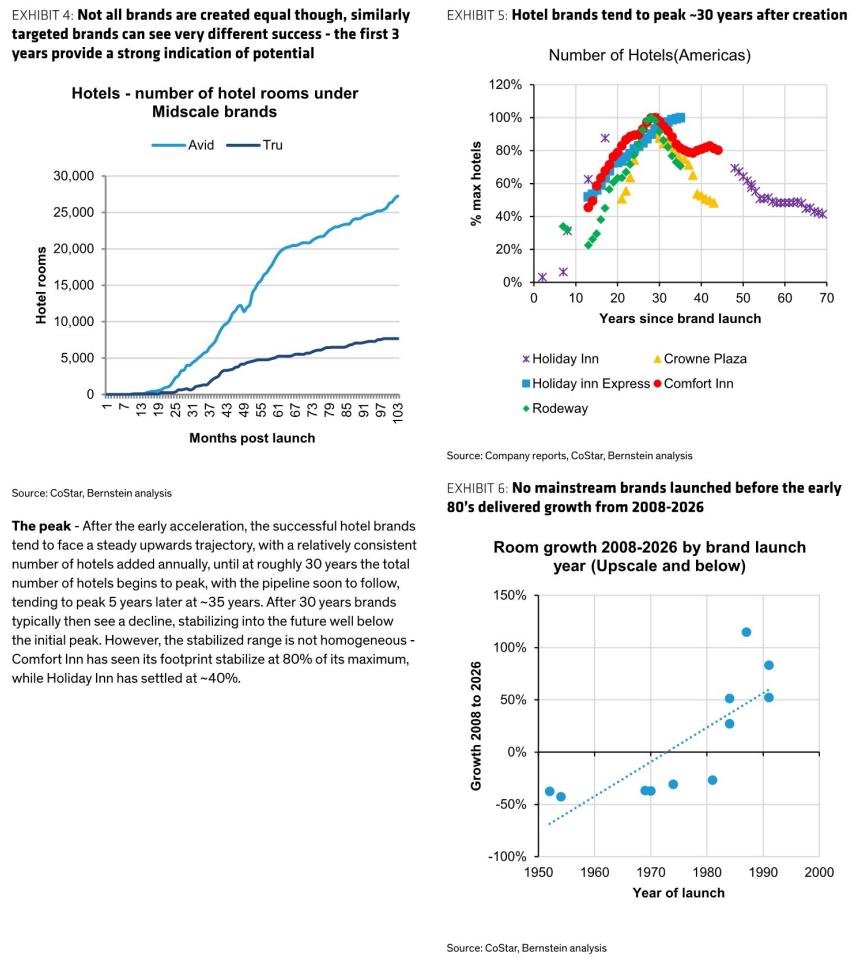
Exhibit 4

Exhibit 5
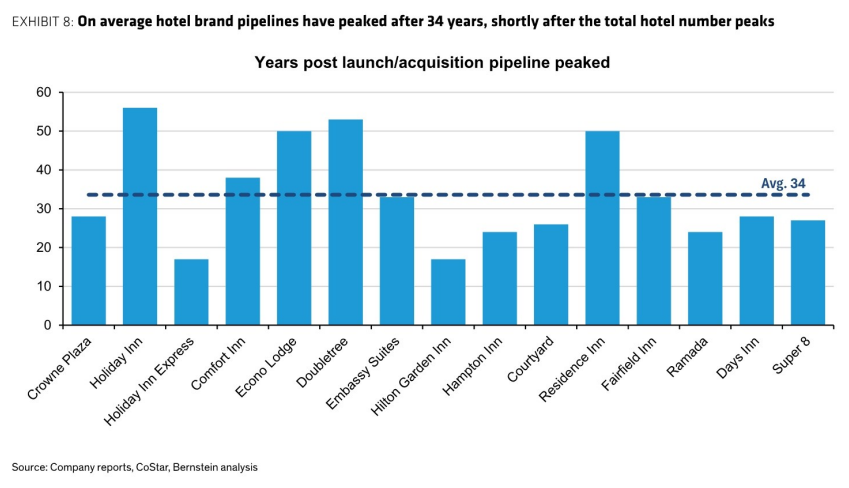
Exhibit 6

Exhibit 7
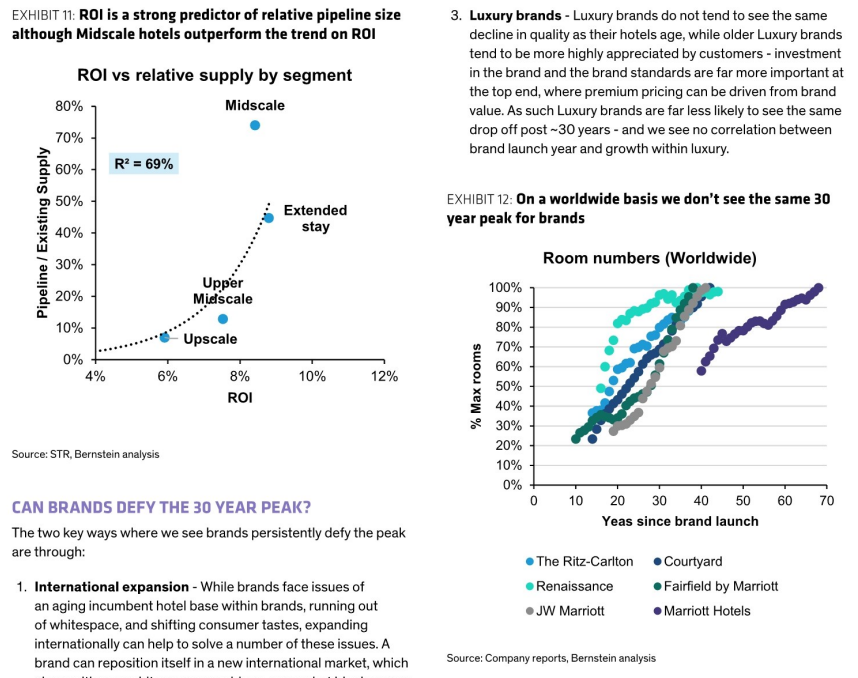
Exhibit 8
