Barclays: US Debt Absorbed by Funds, Foreign Investors, and Pension Funds
Summaries are public. PDF access requires an active membership; all members have the same access. Sign in
Barclays analyzes first-quarter Federal Reserve flow of funds data to assess the evolving buyer base for US debt. Net fixed income issuance targeted at private investors rose to $797 billion in Q1, up from $550 billion in Q4, driven primarily by a significant rebound in corporate bond supply alongside modest increases in agency and municipal debt. Conversely, Treasury supply excluding bills slightly declined.
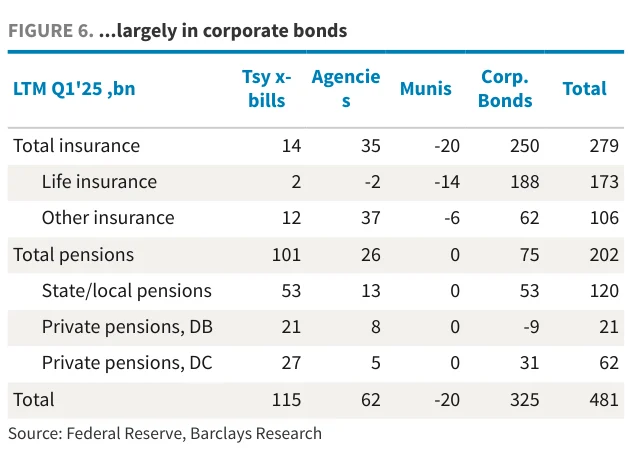
On the demand side, notable buyer rotation occurred. Banks shifted from net sellers of $60 billion in Q4 to buyers of $199 billion in Q1. Foreign investors increased purchases from $83 billion to $232 billion, while broker-dealers and money market funds also stepped up significantly. Mutual funds and ETFs remained the largest buyers, absorbing $304 billion, followed by pension funds and insurance companies at $168 billion, primarily concentrating in corporate credit. This underscores resilient private allocation demand despite rate volatility.
The household sector, acting as a residual, recorded massive net sales of $468 billion, pivoting back toward Treasury bills. Over the trailing four quarters, total net supply to private investors decreased from $3.4 trillion to $2.9 trillion. Asian investors bought bills but sold longer-dated bonds, suggesting overseas demand cannot be blindly relied upon for duration. Ultimately, the market's ability to smoothly absorb US debt depends heavily on the stability of this diversified buyer structure rather than headline issuance volumes.
Key exhibits
Exhibit 1

Exhibit 2
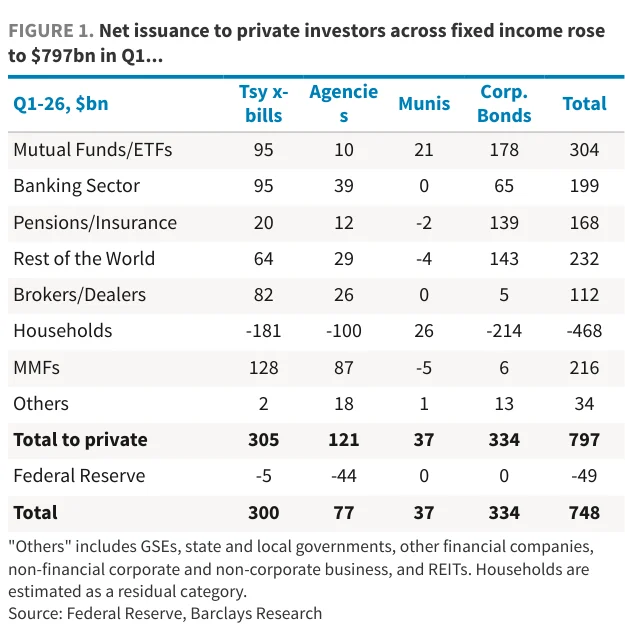
Exhibit 3

Exhibit 4

Exhibit 5

Exhibit 6

Exhibit 7

Exhibit 8