China Musings: Politburo – Policy Preference: Tech Capex over Consumption
Summaries are public. PDF access requires an active membership; all members have the same access. Sign in
Key Views
Q2 real GDP grew 4.3% year-on-year, below the already-revised 4.5–5.0% target. The policy response will focus on accelerating roughly RMB 2 trillion in existing fiscal and quasi-fiscal instruments rather than expanding the budget. Incremental support remains tilted toward capital expenditure, as the global AI race and oil supply shocks reinforce Beijing's supply-side framework, prioritizing tech self-sufficiency and energy security.
Consumption takes a back seat. The five-year pro-consumption plan targets RMB 60 trillion in retail sales by 2030, yet the implied CAGR of just 3.7% barely exceeds the past four-year average, signaling policymakers' acceptance of a lower post-pandemic consumption trajectory. Administrative micro-adjustments — such as easing auto purchase restrictions and optimizing housing provident funds — represent the path of least resistance.
Outlook
The 2026 full-year GDP growth forecast was revised down 20 basis points to 4.6%, with Q3 at 4.5% and Q4 at 4.7% year-on-year. The two-speed economy deepens, with infrastructure and exports as primary engines while consumption stays soft. The RMB CFETS index recently reached approximately 102.5, leaving limited room for further appreciation. The USD/RMB year-end target holds at 6.75, with near-term potential to move toward 6.70.
Recommended Securities
No specific securities were recommended.
Key exhibits
Exhibit 1
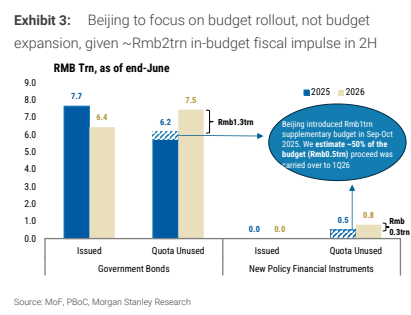
Exhibit 2
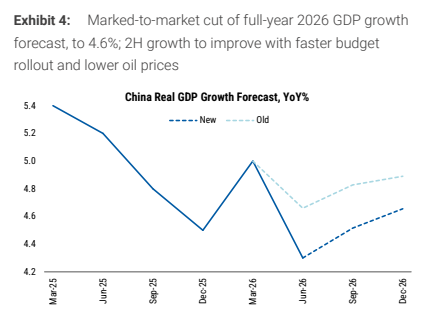
Exhibit 3
