Global Semis: Progress of Foundry Decoupling up to 2025
Summaries are public. PDF access requires an active membership; all members have the same access. Sign in
Bernstein analyzes the ongoing decoupling between Chinese and non-Chinese markets in the global semiconductor foundry sector through 2025. Despite persistent geopolitical tensions, the actual pace of decoupling remains significantly slower than market expectations, characterizing it as a multi-year structural theme rather than a rapid disruption.
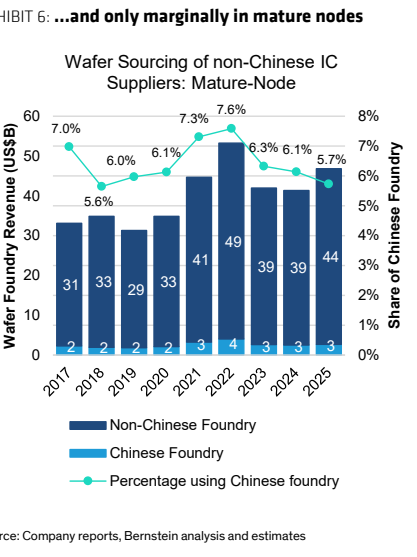
In 2025, Chinese integrated circuit suppliers sourced 32% of their advanced node demand from domestic foundries, a notable increase from 25% in 2024. For mature nodes, domestic fulfillment reached 59%, up only slightly from 57%. Conversely, non-Chinese IC suppliers reduced their reliance on Chinese foundries, with mature node fulfillment dropping to 5.7% from 6.1%. For advanced nodes, all non-Chinese IC suppliers entirely avoided Chinese foundries.
Although Chinese foundries like SMIC have aggressively expanded capacity, their global market share in advanced nodes remains limited to just 3.5%. Meanwhile, Chinese IC suppliers hold an 11% global share in advanced nodes, implying a domestic self-sufficiency rate of only 32%. For mature nodes, Chinese foundries hold a 21% global share, equating to a 72% self-sufficiency rate. Aggressive capacity expansion by Chinese foundries, characterized by high capital expenditure relative to revenue, has yet to translate into substantial global share gains.
Bernstein provides institutional ratings and price targets covering several key players: TSMC (2330.TT/TSM, Outperform, NT$2,780.00 / US$430.00), UMC (2303.TT/UMC, Underperform, NT$47.00 / US$7.40), Vanguard (5347.TT, Market-Perform, NT$94.00), SMIC (981.HK/688981.CH, Outperform, HK$120.00 / CNY 220.00), and Hua Hong Semiconductor (1347.HK/688347.CH, Outperform, HK$220.00 / CNY 370.00).
Key exhibits
Exhibit 1
Exhibit 2
Exhibit 3
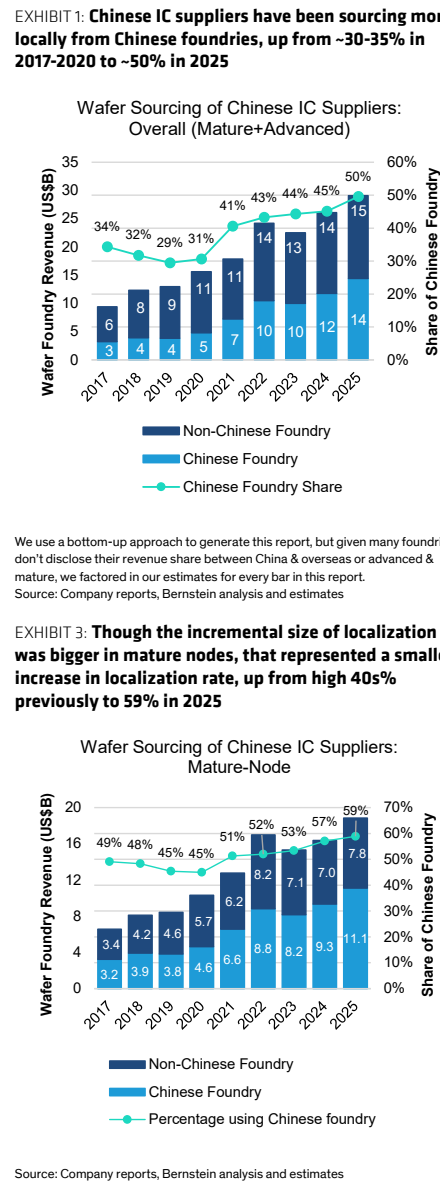
Exhibit 4
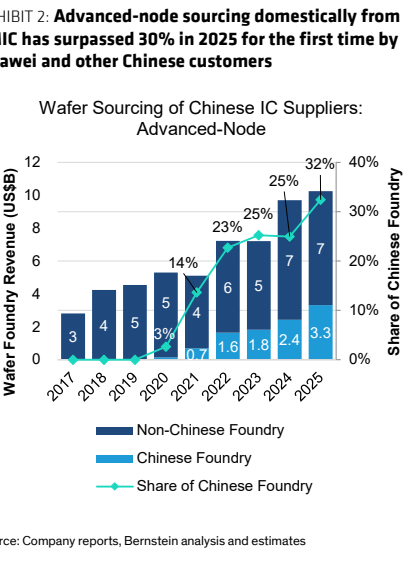
Exhibit 5
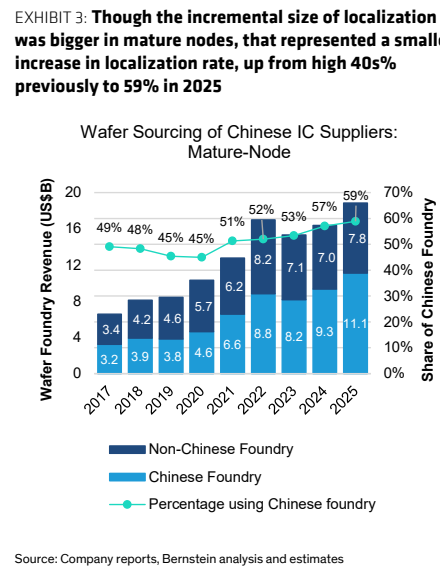
Exhibit 6
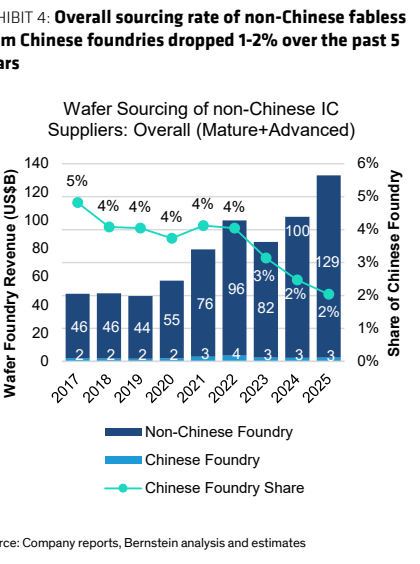
Exhibit 7
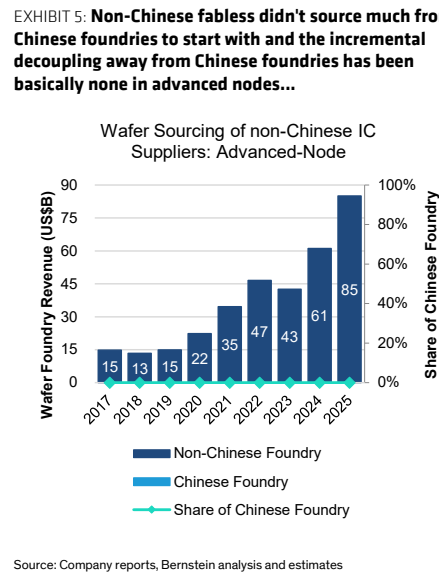
Exhibit 8