BofA China Internet: China AI Handbook 3 - AI Agent Launch Wave; Reading the China Market, Tencent Preferred
Summaries are public. PDF access requires an active membership; all members have the same access. Sign in
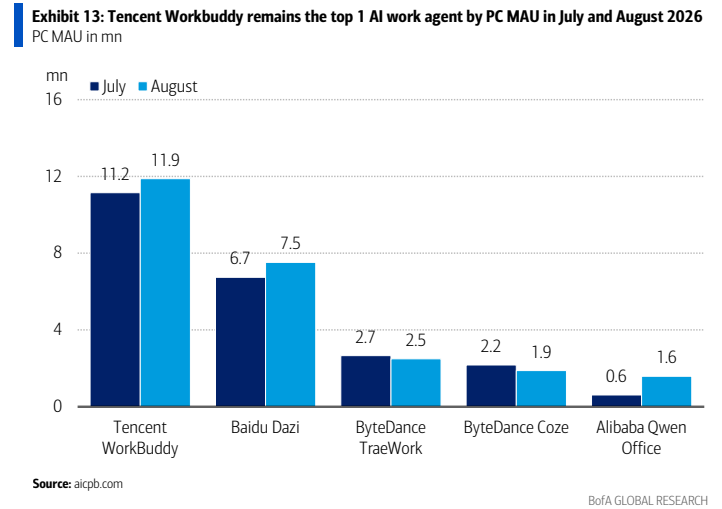
The third installment of BofA's China AI handbook examines the wave of AI agent launches and argues that China's closed mobile internet ecosystem favors agents embedded in existing super-apps over cross-platform general-purpose assistants. On the consumer side, Tencent is best positioned, leveraging contextual advantages and user stickiness within WeChat. On the enterprise side, collaboration platforms hold structural advantages through workflow distribution and corporate-context understanding, where the competitive battleground is workflow control rather than model capability. BofA estimates China has roughly 95 million private-sector white-collar workers, implying a potential annual total addressable market above RMB 100bn. Monetization remains early stage: subscription models are expected to see low penetration in China, and labor substitution poses a latent risk to consumption demand. Tencent's WeCom shows stronger engagement than DingTalk, whose daily active users fell to 74 million in August 2026, and Tencent's WorkBuddy ranks as the leading PC-based AI office assistant. ByteDance apps lifted their share from 34% in August 2025 to 41% a year later. BofA expects a multi-agent landscape with data silos across Tencent, Alibaba, ByteDance and OEM ecosystems, while edge-AI migration supports tiered models and lower inference costs. Tencent (TCTZF/700 HK) is rated Buy, Alibaba (BABA/9988 HK) Buy, and Meituan (MPNGF/3690 HK) Neutral.
Key exhibits
Exhibit 1
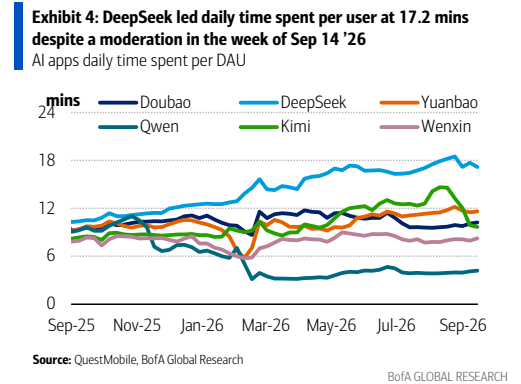
Exhibit 2
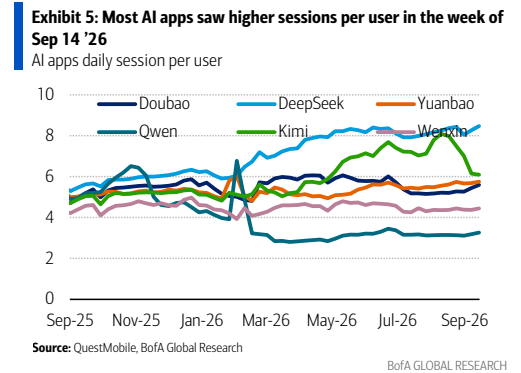
Exhibit 3
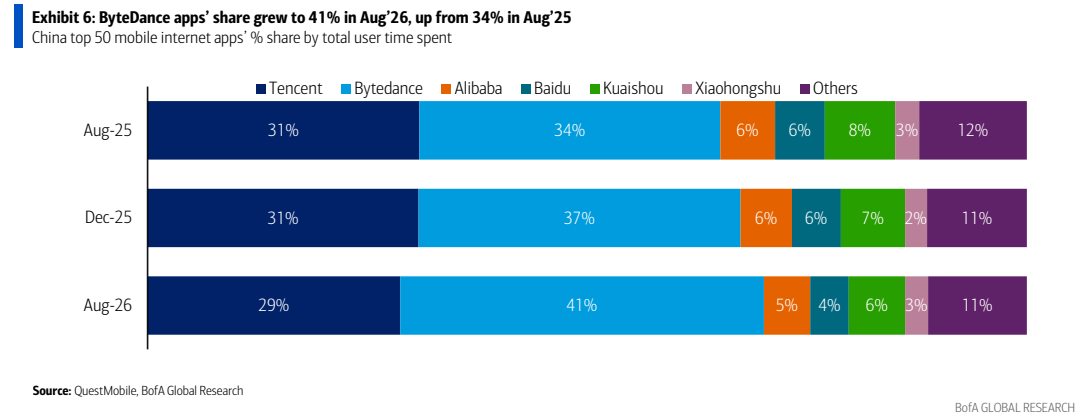
Exhibit 4
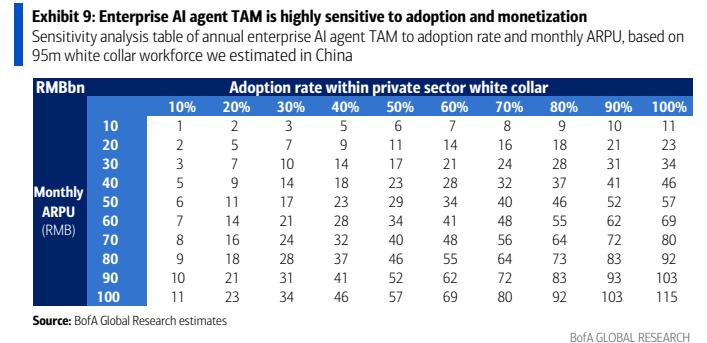
Exhibit 5
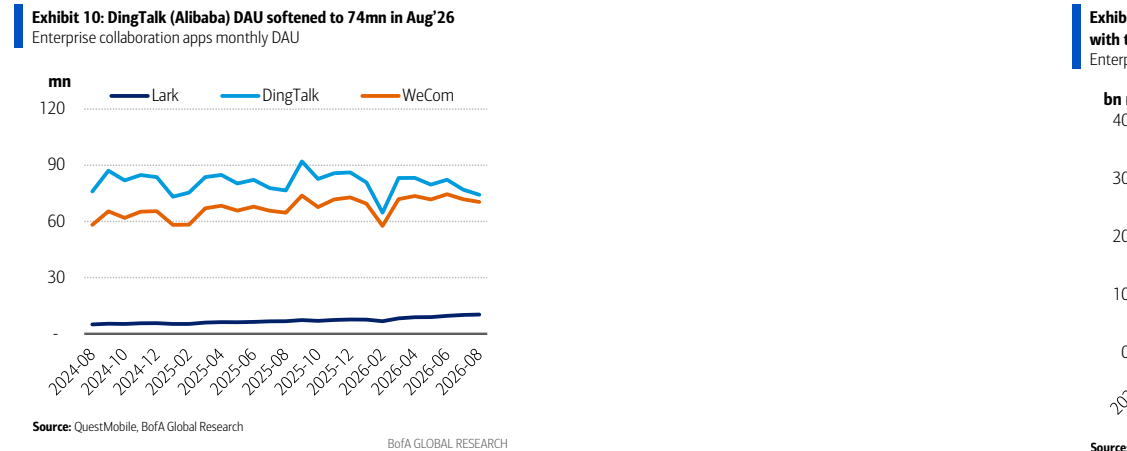
Exhibit 6
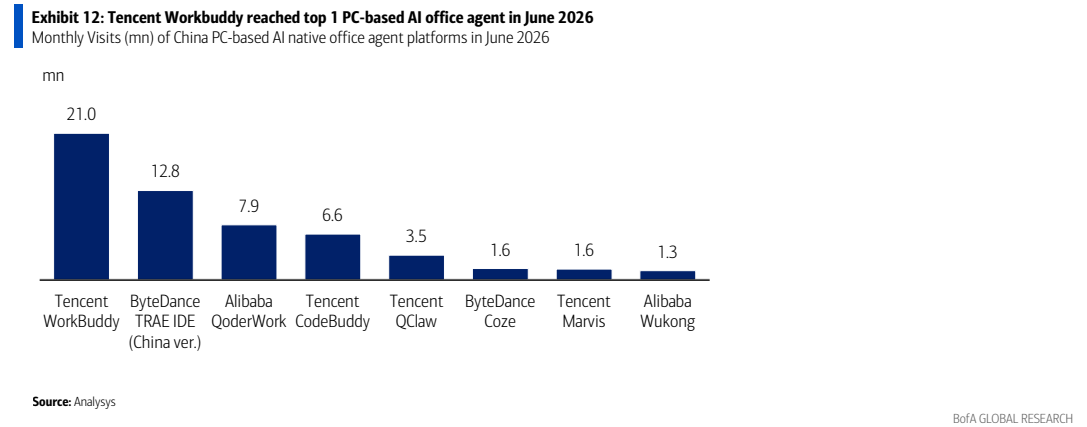
Exhibit 7