Goldman Sachs Global Markets Daily: More JPY Weakness to Come Without a Shift in the Macro Backdrop
Summaries are public. PDF access requires an active membership; all members have the same access. Sign in
Goldman Sachs analysts anticipate further Japanese yen depreciation against the US dollar unless the underlying macroeconomic backdrop shifts significantly. The yen recently plunged to a 40-year low, prompting the Ministry of Finance to consider additional currency intervention. However, Goldman argues that several structural factors—including higher-for-longer US yields, low recession risk, sustained US fiscal concerns, and the Bank of Japan's gradual approach to rate hikes—will continue to drive yen weakness.
Historically, USD/JPY movements correlated tightly with US-Japan real interest rate differentials. Over the past year, however, this relationship has weakened. Instead, the exchange rate has become highly sensitive to the relative rise in Japanese government bond term premiums compared to US Treasuries. Since July 2025, whenever Japan's term premium rose relative to the US, USD/JPY appreciated by an average of 0.35%.
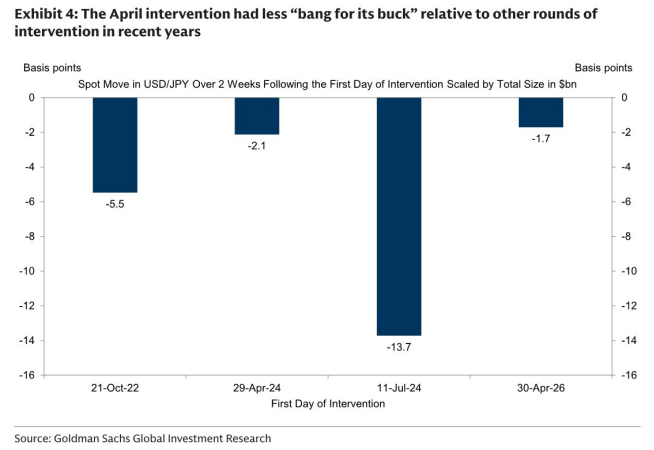
Goldman notes that while currency intervention has temporarily capped USD/JPY upside this year, its impact remains fleeting if macro fundamentals persist. The Japanese fiscal stimulus and gradual monetary tightening will likely keep upward pressure on JGB term premiums. Barring a negative US growth shock or a sudden hawkish pivot from the BOJ—both deemed unlikely over the next year—the dollar's upward trajectory against the yen should continue.
Consequently, Goldman revised its USD/JPY forecast path upward to 162 in three months, 163 in six months, and 165 in twelve months, from previous estimates of 160, 158, and 155. The firm continues to recommend using the yen as a primary funding currency for high-yield emerging market carry trades and other G10 low-yield currency expressions.
Key exhibits
Exhibit 1
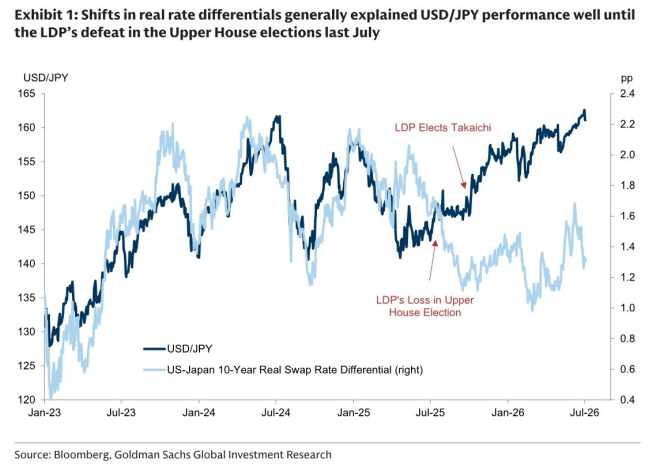
Exhibit 2
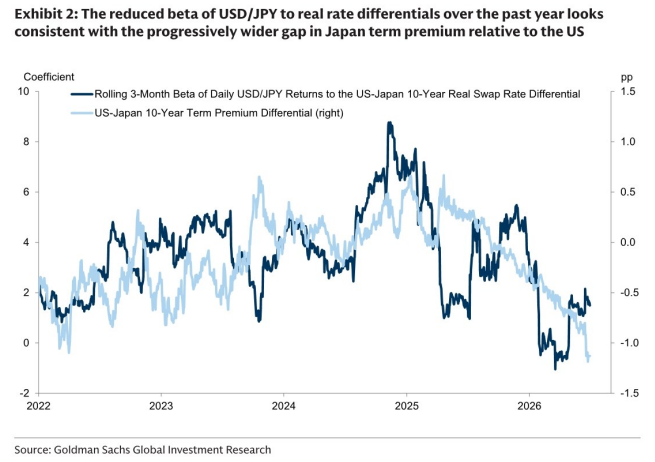
Exhibit 3
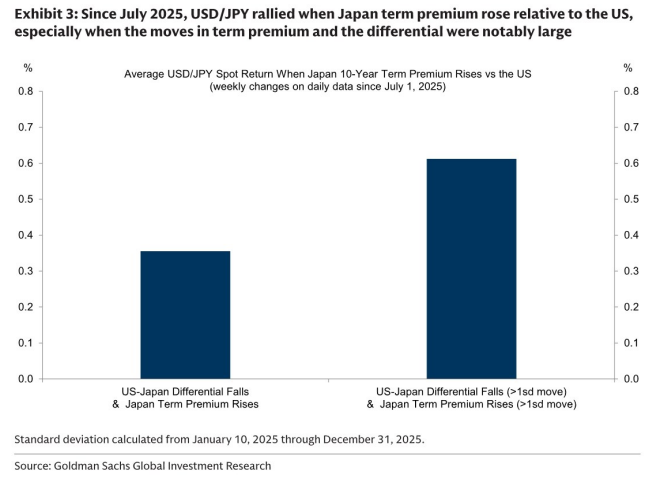
Exhibit 4

Exhibit 5