Bernstein: Best of Times, Worst of Times — Lodging & Cruise: If They Come, Will They Build Them?
Summaries are public. PDF access requires an active membership; all members have the same access. Sign in
Bernstein highlights a pronounced K-shaped divergence in 2026 travel consumption, driven by strong demand from high-income consumers. Between January and May 2026, US luxury hotel revenue grew 9.1%, while economy hotels contracted 2.7%. This trend extends to cruises; Viking's Q1 2026 net yields rose 9.5%, whereas Norwegian Cruise Line saw a 0.3% decline. Delta Air Lines noted its premium revenue is growing at roughly double the pace of total ticket revenue.
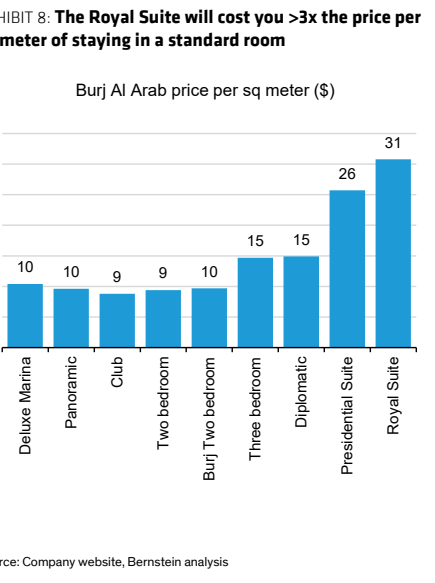
Supply dynamics vary by sector. While vertically integrated operators like cruise lines and airlines actively expand premium capacity—luxury cruise capacity is set to grow over 10% in 2026—luxury hotel supply remains severely constrained. High construction, financing, and labor costs deter developers, who prioritize speed and returns akin to funding a $500K Wingstop rather than an $8M Ruth's Chris. Consequently, mid-scale and upper-midscale hotel supply is outpacing luxury additions.
This structural shortage of luxury hotel rooms is expected to sustain RevPAR growth for years. Notably, US luxury chain hotels saw a 17.4% RevPAR surge the week before the June 14 World Cup. Operators may increasingly pursue M&A to gain luxury exposure, exemplified by recent deals involving Lefay, Standard, and Graduate. Online travel agencies have limited direct exposure to five-star hotels but benefit from the broader travel strength. Bernstein maintains Outperform ratings on Viking, Hyatt, Marriott, Melia Hotels, Airbnb, Royal Caribbean, and TripAdvisor, while holding Market-Perform ratings on Booking, Carnival, Expedia, Hilton, IHG, Norwegian, and TUI.
Key exhibits
Exhibit 1

Exhibit 2
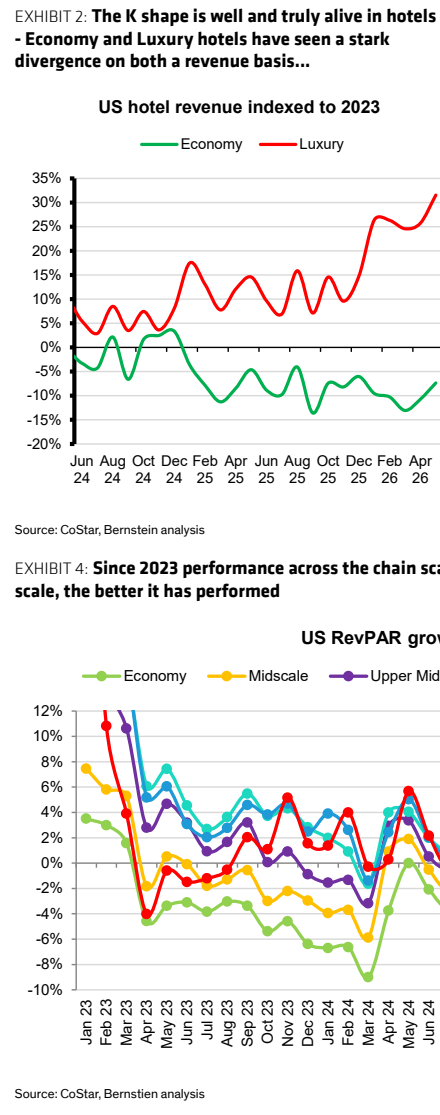
Exhibit 3
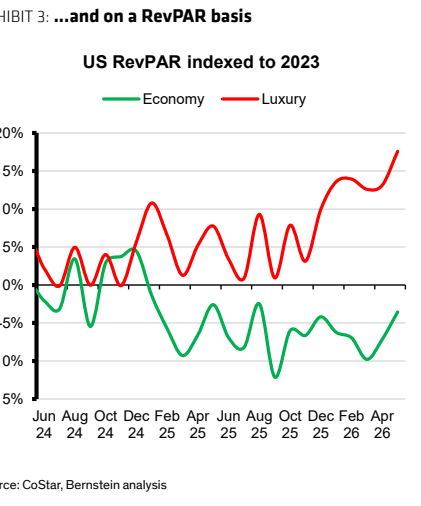
Exhibit 4

Exhibit 5
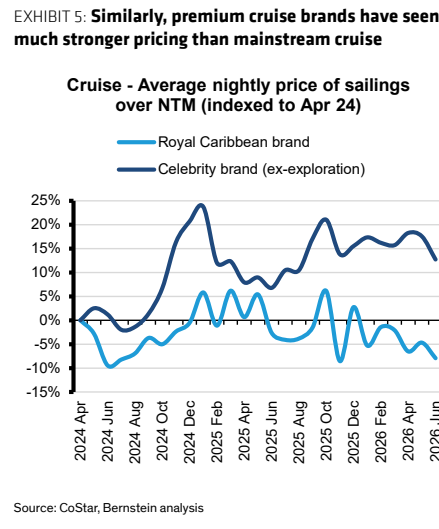
Exhibit 6
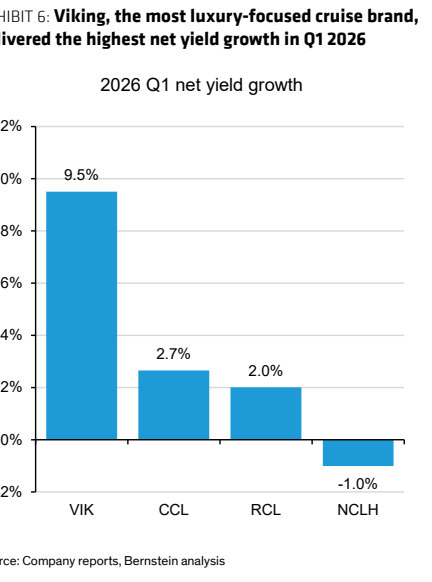
Exhibit 7
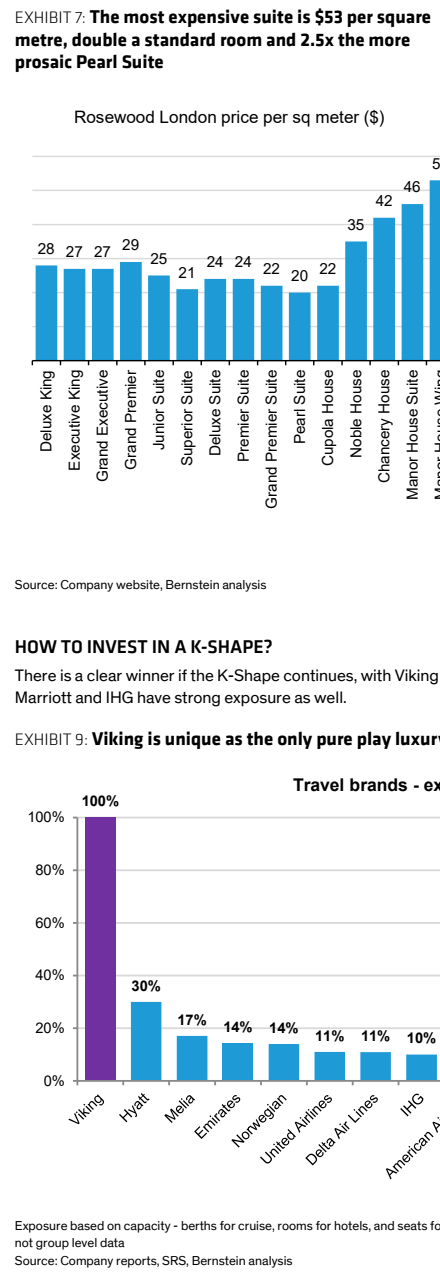
Exhibit 8