Morgan Stanley China's Emerging Frontiers: Rewiring the Home - A Roadmap of Appliances in AI Diffusion
Summaries are public. PDF access requires an active membership; all members have the same access. Sign in
Morgan Stanley argues that artificial intelligence is fundamentally transforming China's home appliance sector, shifting products from replacement hardware into servable household infrastructure. The total China appliance and AI services market is projected to expand from $123 billion in 2025 to $150 billion by 2030, reflecting a 4% compound annual growth rate. The intelligent and AI-enabled segment is expected to grow at a faster 12% CAGR, reaching approximately $115 billion and capturing 75% of the total addressable market by 2030.
Robot vacuums represent the most immediate AI beneficiary, with a projected 16% CAGR through 2030, expanding from roughly $2 billion to $6 billion. AI broadens the market through five channels: premiumization supporting higher average selling prices, accelerated replacement cycles, entirely new product categories, recurring service revenues, and the industrialization of household chores.
Incumbent leaders including Midea, Haier, Xiaomi, Roborock, and Ecovacs are positioned to remain the primary winners over the next three to five years, leveraging advantages in manufacturing scale, established brands, global supply chains, and extensive service networks. These companies are also utilizing AI to reduce costs, with Midea targeting a 0.3 percentage point reduction in manufacturing expense ratios for 2026 and Haier aiming for annual savings of 0.3 to 0.5 percentage points. While long-term disruption from agentic AI and humanoid robots remains a risk, near-term displacement appears unlikely.
Key exhibits
Exhibit 1
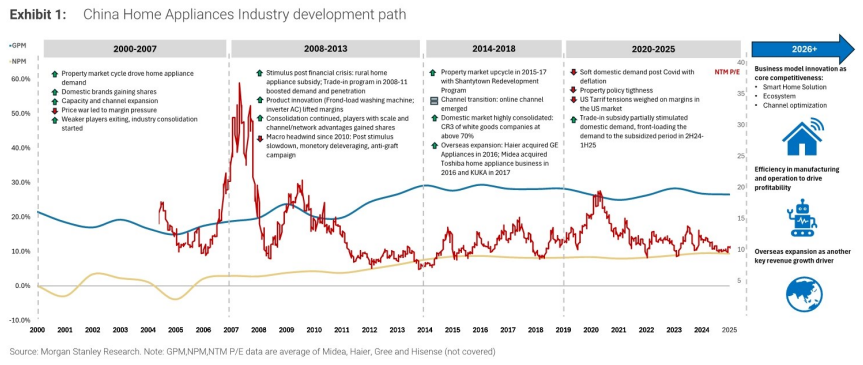
Exhibit 2
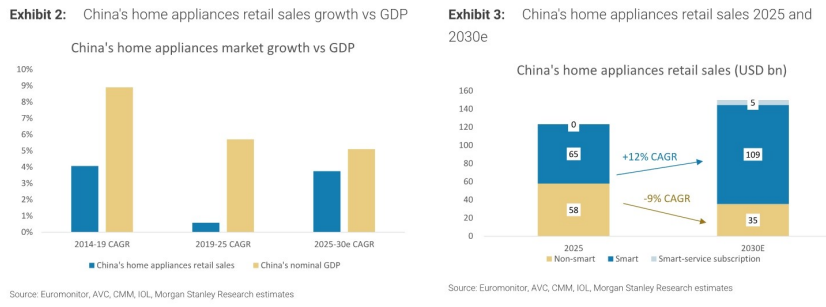
Exhibit 3

Exhibit 4
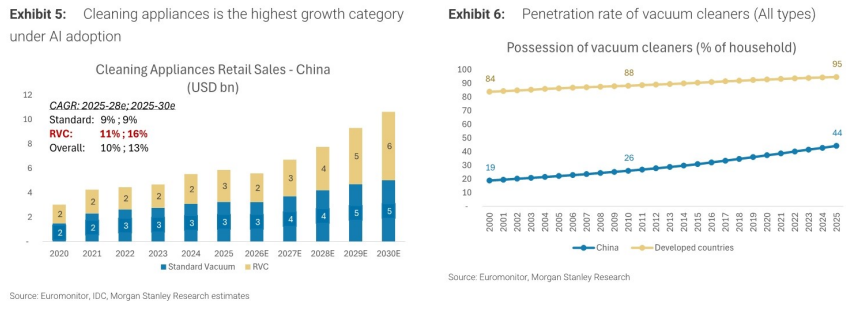
Exhibit 5

Exhibit 6

Exhibit 7

Exhibit 8
