Framing the Growth Narrative
Summaries are public. PDF access requires an active membership; all members have the same access. Sign in
Key Views
The growth cluster now accounts for 55% of S&P 500 market capitalization and nearly 48% of earnings, with analysts projecting 42% EPS growth in 2026—the primary source of the index's 24% earnings growth. AI infrastructure and semiconductor entrants such as Broadcom, Micron, and AMD are expanding beyond traditional mega-caps, rendering narrow grouping methods obsolete.
The growth cluster's forward P/E sits near the 66th percentile of its 30-year history and is not materially more expensive relative to its own past than cyclical or defensive clusters. Persistent earnings beats and upward revisions support this valuation, with 2026 consensus EPS revised up roughly 30% over the past year.
Outlook
Rising cluster dominance reduces the S&P 500's representativeness of the broader US economy and elevates sensitivity to AI and tech capital expenditure. Higher growth-stock beta implies structurally elevated realized volatility. If earnings revisions remain concentrated in the growth cluster, its dominance will solidify; conversely, disappointed AI capex returns or semiconductor demand could amplify index drawdowns.
Recommended Securities
- Growth and AI infrastructure cluster: Benefits from earnings revisions but carries concentration risk.
- Semiconductors and enablers: Key earnings contributors; watch demand cycles.
- Cyclical and defensive clusters: Serve as relative-value hedges against growth-cluster beta.
Key exhibits
Exhibit 1

Exhibit 2

Exhibit 3

Exhibit 4

Exhibit 5

Exhibit 6

Exhibit 7

Exhibit 8

Exhibit 9

Exhibit 10

Exhibit 11

Exhibit 12

Exhibit 13
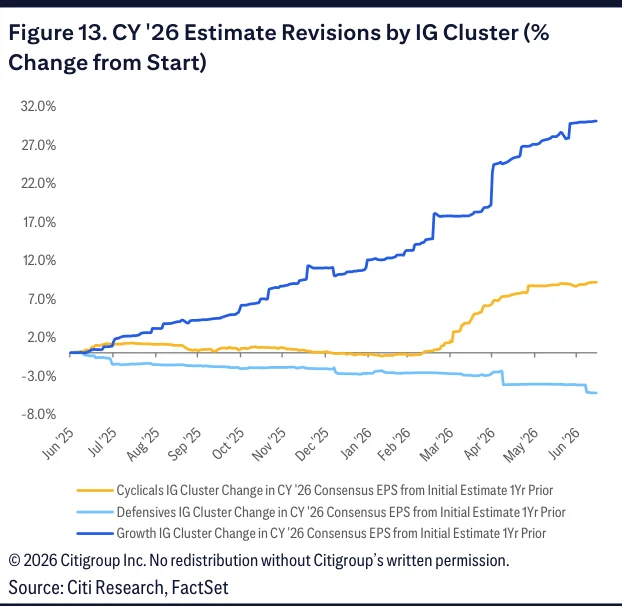
Exhibit 14

Exhibit 15

Exhibit 16

Exhibit 17
