Goldman Sachs ASIA IN FOCUS: Korea and Taiwan—How To Manage AI-Driven Super Surplus
Summaries are public. PDF access requires an active membership; all members have the same access. Sign in
Goldman Sachs reports that surging demand for artificial intelligence (AI) will drive South Korea and Taiwan to generate massive current account surpluses between 2026 and 2030, with a combined total potentially exceeding $1 trillion. The report analyzes strategies for managing these "super surpluses," focusing on investment allocation, exchange rate policies, and capital flow management.
The primary drivers of this surplus are semiconductor exports, as both nations occupy critical positions in the global AI chip supply chain. However, uncertainty surrounding the AI investment cycle introduces significant risks. If demand slows, the projected surpluses could shrink substantially.
To mitigate pressure from these surpluses, the report recommends that Korea and Taiwan expand their overseas direct investments, particularly into AI infrastructure and energy sectors. Exchange rate policies should become more flexible, allowing for moderate currency appreciation to absorb part of the surplus. Additionally, opening capital accounts can facilitate capital outflows, alleviating domestic asset price pressures.
Central banks in both countries may face intervention pressure, though the effectiveness of such interventions is limited. The report forecasts that the Bank of Korea will maintain interest rates unchanged, while the Central Bank of Taiwan might implement a modest rate hike to curb inflation. Key charts illustrate the projected surge in AI-related exports, the resilience of chip-energy balances even under adverse energy scenarios, and the distinct volatility patterns between the Korean and Taiwanese tech cycles compared to non-tech sectors.
Key exhibits
Exhibit 1
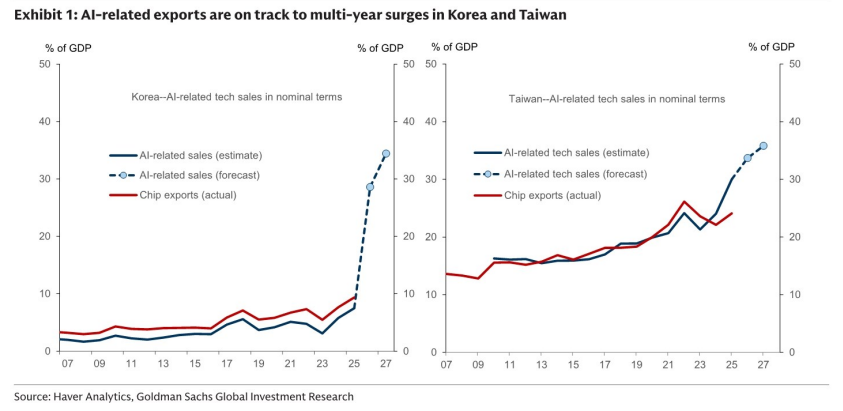
Exhibit 2
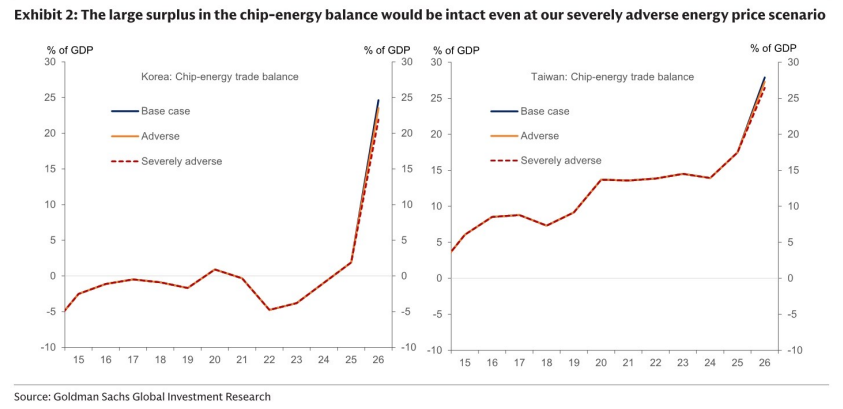
Exhibit 3

Exhibit 4
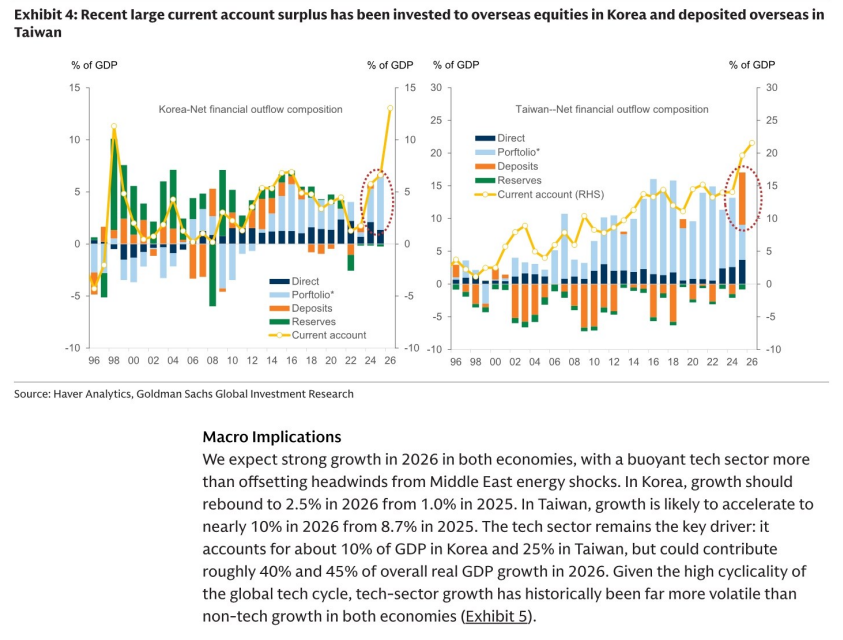
Exhibit 5

Exhibit 6

Exhibit 7
