Barclays US CPI Monitor: Shelter Quirk Does Not Change Rate Hold
Summaries are public. PDF access requires an active membership; all members have the same access. Sign in
Barclays notes that the seemingly strong headline US April CPI report was primarily driven by one-off adjustments in energy prices and shelter inflation rather than a broad-based, extrapolatable acceleration in underlying inflation. Core CPI accelerated 18 basis points month-over-month to 0.38%, yielding a 2.8% year-over-year rate. However, rent and owners' equivalent rent experienced anomalous jumps because the Bureau of Labor Statistics interpolated missing October data. Barclays estimates this technical adjustment alone contributed roughly 12 basis points to the core CPI print.
Simultaneously, core goods inflation softened, suggesting that tariff-related price pressures are fading. Apparel remained an exception, reflecting lagged tariff pass-through. After mapping the CPI data to PCE categories, Barclays estimates core PCE inflation at 0.35% month-over-month and 3.4% year-over-year, slightly above prior estimates.
Looking forward, the bank expects May shelter inflation to normalize significantly, with monthly rent growth returning to a 0.23% to 0.25% range. May core CPI is projected at 0.24% month-over-month. For the medium term, Barclays maintains its Q4/Q4 core CPI forecast at 3.0% for 2026 and 2.4% for 2027. This outlook incorporates a proprietary baseline oil price path that assumes 2026 Brent crude averages 100 dollars per barrel, which is higher and more persistent than futures curves suggest.
Regarding monetary policy implications, the Federal Reserve will likely maintain a patient stance. The one-off shelter anomaly is not extrapolatable, but consecutive elevated core PCE readings and persistent energy price risks will keep the FOMC on hold.
Key exhibits
Exhibit 1

Exhibit 2

Exhibit 3

Exhibit 4
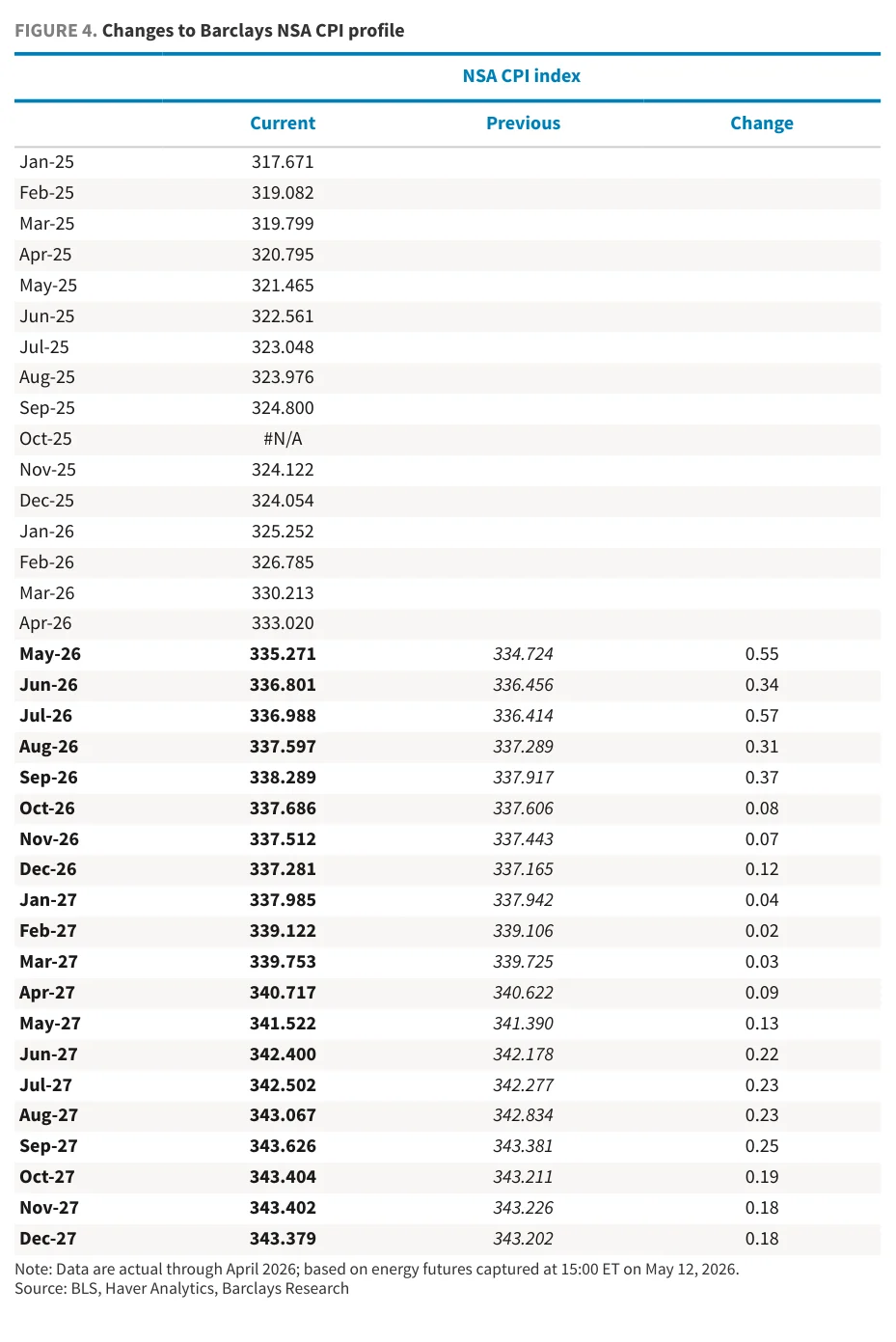
Exhibit 5
