US Daily: Is Nominal Bias Boosting the Business Surveys?
Summaries are public. PDF access requires an active membership; all members have the same access. Sign in
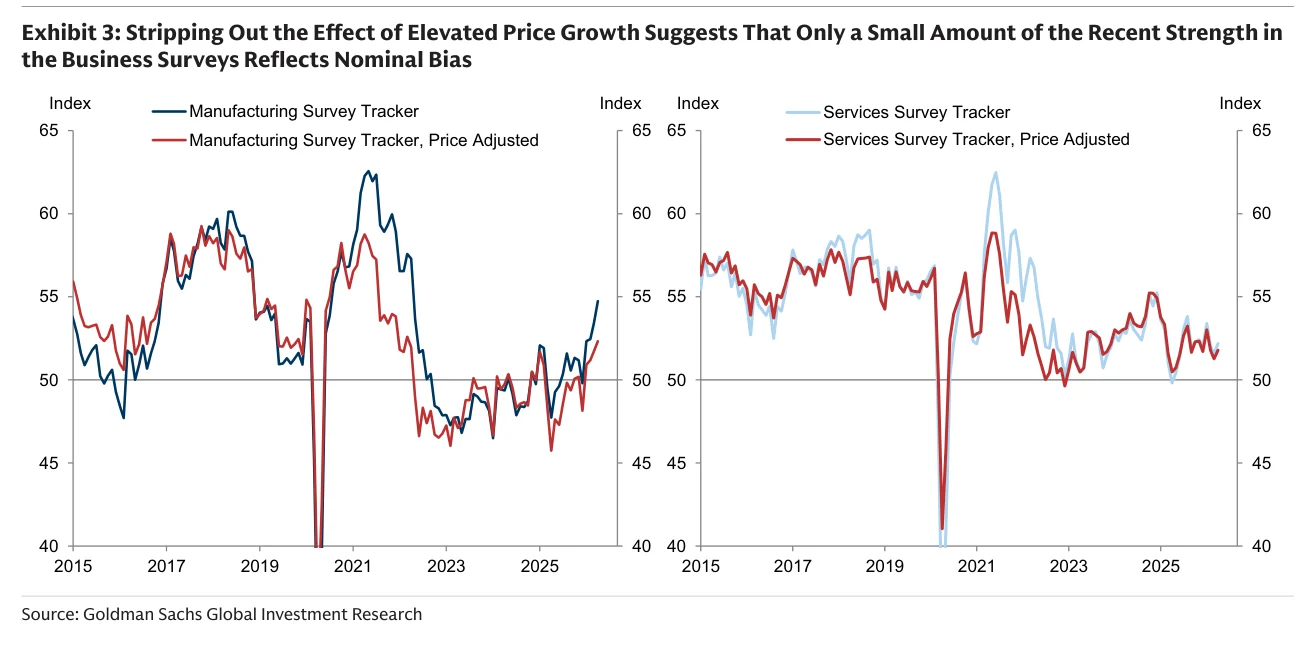
Goldman Sachs investigates why US business surveys have remained resilient through early this year despite an oil price shock linked to the Iran war that theoretically should have dampened demand and business confidence. Manufacturing surveys have strengthened notably, with Goldman's manufacturing survey tracker rising 5.0 points to 54.7 between last December and April, while the service sector tracker edged up 0.2 points to 52.2.
A key question is whether nominal bias is inflating headline readings. Some respondents may answer questions about orders and shipments in dollar terms rather than real quantities. Goldman's composite prices-charged sub-indices for both manufacturing and services reached multi-year highs by April. Because rising prices can be mistaken for genuine activity gains, the firm ran regressions of headline indices on prices-charged components and real activity proxies—manufacturing production and PCE services, respectively.
The results confirm a statistically significant positive correlation between prices charged and headline indices across nearly all surveys, indicating nominal bias is real. However, after price adjustment, the manufacturing tracker still rose 4.2 points to 52.4 and the services tracker gained 0.1 points to 51.8 since December. This means only a small portion of recent gains stems from nominal bias, while genuine activity improvement persists. Goldman attributes manufacturing resilience partly to fading tariff headwinds, pro-investment fiscal policy, and AI-related capital spending, cautioning investors against overinterpreting unadjusted headline strength.
Key exhibits
Exhibit 1

Exhibit 2

Exhibit 3