Goldman Sachs Oil Tracker: Strong Non-Gulf Crude Exports and Weak China Demand Partially Offset Tightening From Very Low Gulf Exports
Summaries are public. PDF access requires an active membership; all members have the same access. Sign in
Goldman Sachs' latest oil tracker highlights a divergence in global crude export patterns. Gulf crude exports have fallen to extremely low levels, which would normally exert significant tightening pressure on the market. However, this bullish signal is being partially neutralized by two countervailing forces.
First, non-Gulf crude exports, particularly from the Americas, have surged notably. Data shows this increase is offsetting roughly 45% of the disruption to Persian Gulf crude and condensate shipments. Second, Chinese oil demand has weakened considerably. Goldman's demand nowcast for China has declined by 1.5 million barrels per day, or 8%, since mid-March, reflecting softer consumption.
These offsetting dynamics leave the global market in a state of mixed signals. Goldman estimates the total impact on Persian Gulf oil flows at approximately 16 million barrels per day. Separately, Iranian total oil loadings have dropped to 700,000 barrels per day on a seven-day moving average. The report also notes that a potential release of 1.2 million barrels per day of OECD strategic petroleum reserves could mitigate the impact on global commercial inventories. Visible onshore inventories across Asia, excluding China and India, declined by 2.5 million barrels per day over the prior fourteen days.
Key exhibits
Exhibit 1

Exhibit 2

Exhibit 3
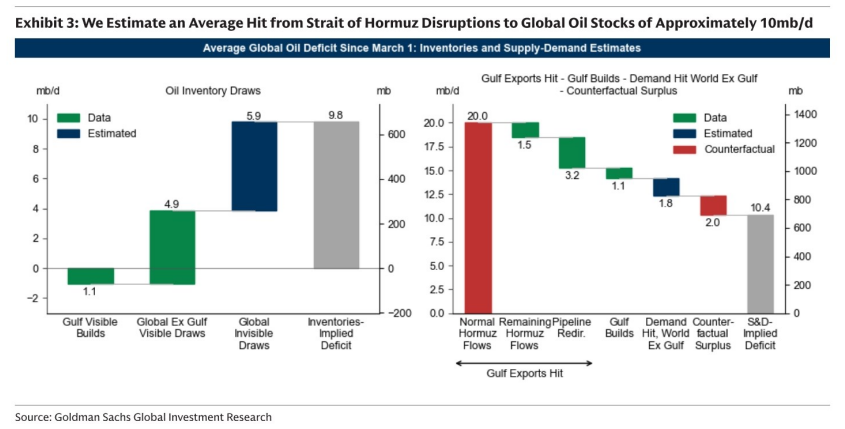
Exhibit 4

Exhibit 5
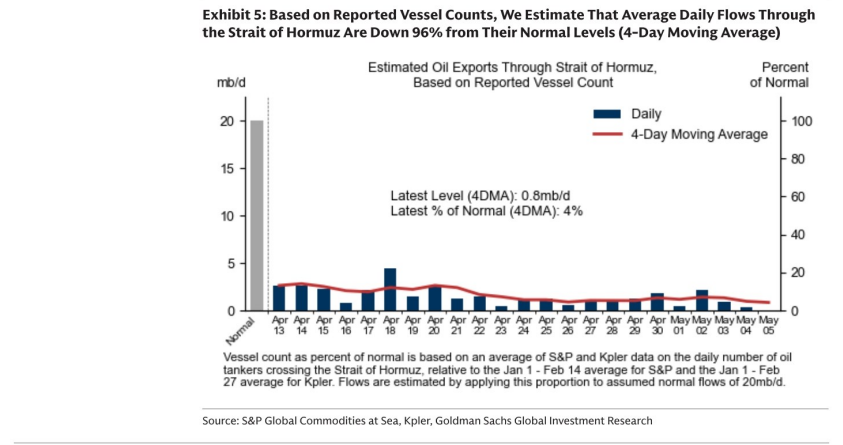
Exhibit 6

Exhibit 7
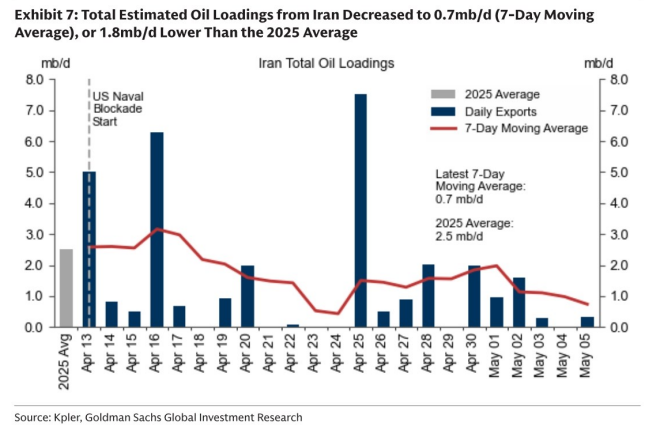
Exhibit 8
