UBS Global Precious Metals Comment: Demystifying Official Sector Gold Flows
Summaries are public. PDF access requires an active membership; all members have the same access. Sign in
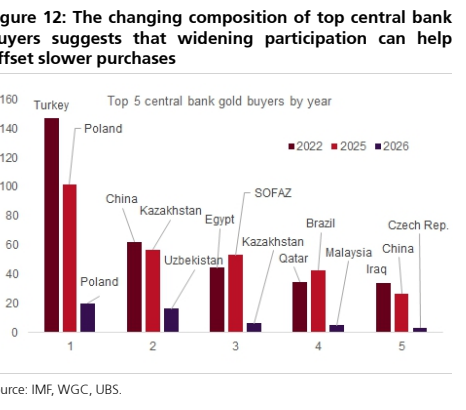
A UBS report analyzes the drivers and trends behind official sector gold flows. In 2025, global central bank gold purchases reached 1,045 tons, marking the third consecutive year above the 1,000-ton threshold. However, purchases slowed by 12% year-over-year in the first quarter of 2026, settling at 228 tons. Emerging market central banks remain the dominant buyers, led by China, Poland, and Turkey, and account for 85% of global official demand.
The primary motivations for these purchases include reserve diversification (40%), geopolitical risk hedging (30%), and de-dollarization (20%). UBS projects that full-year 2026 central bank gold acquisitions will remain robust at 900 to 1,000 tons. Meanwhile, gold forward offered rates (GOFO) rose to 0.8% in the first quarter of 2026, up from the 2025 average of 0.5%. This increase, alongside a decline in central bank gold swap balances from 1,200 tons to 1,050 tons, suggests that central banks are reducing gold lending in favor of holding physical bullion.
China purchased 225 tons in 2025 and 45 tons in early 2026. Poland and Turkey acquired 130 tons and 120 tons, respectively. Conversely, Kazakhstan shifted to a net seller. Key downside risks include the potential for gold prices to exceed $3,000 per ounce, which could suppress central bank appetite.
Key exhibits
Exhibit 1
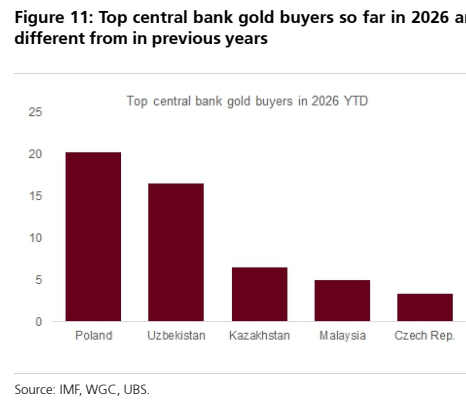
Exhibit 2