Goldman Sachs: A Commodity Primer for Portfolio Managers
Summaries are public. PDF access requires an active membership; all members have the same access. Sign in
Goldman Sachs provides a comprehensive framework for portfolio managers to allocate commodities effectively based on distinct macroeconomic inflation mechanisms. The report explains that commodity prices simultaneously process future marginal supply costs and current inventory dynamics. Long-term futures prices establish a marginal cost anchor, while deviations in spot prices reflect immediate physical market tightness.
The firm emphasizes that inflation is not a monolithic scenario. Late-cycle inflation, characterized by demand exceeding capacity and shrinking inventories, is best hedged using cyclical commodities like oil and industrial metals. Conversely, supply disruption inflation requires a broadly diversified commodity basket excluding precious metals. Gold serves as the most effective hedge against institutional credibility risks, such as doubts surrounding central bank independence, fiscal discipline, or reserve asset neutrality.
While commodities exhibit high volatility, they frequently provide vital portfolio protection during stagflationary periods when traditional equities and bonds decline simultaneously. Because commodity price increases only partially pass through to consumer inflation, a small strategic allocation can effectively reduce overall portfolio risk without consuming excessive risk budgets.
To construct an optimal commodity allocation, Goldman Sachs suggests starting with traditional benchmarks like the Bloomberg Commodity Index, which offers balanced exposure across energy, metals, and agriculture. Investors should then customize their exposure by incorporating regional energy contracts, tilting toward specific inflation scenarios, and implementing enhanced roll-yield strategies to capitalize on backwardation or mitigate contango drag. Commodity producer equities are deemed an inadequate substitute for direct commodity exposure due to their high equity market correlation and operational risks.
Key exhibits
Exhibit 1

Exhibit 2

Exhibit 3

Exhibit 4

Exhibit 5

Exhibit 6

Exhibit 7

Exhibit 8

Exhibit 9

Exhibit 10

Exhibit 11

Exhibit 12

Exhibit 13

Exhibit 14
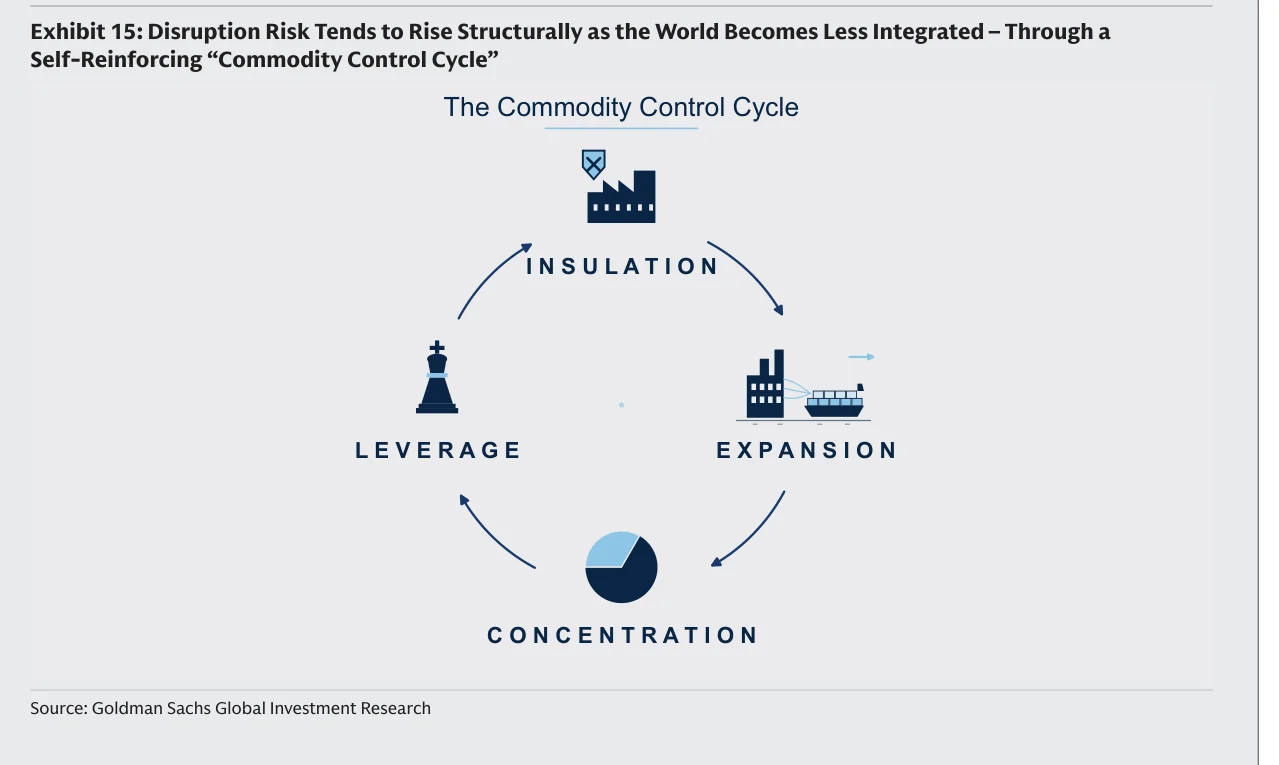
Exhibit 15

Exhibit 16

Exhibit 17

Exhibit 18

Exhibit 19

Exhibit 20

Exhibit 21
